
You notice it one morning — a corner of your shoe or handbag is lifting, curling, flaking. The leather is peeling. It looks terrible, it’s getting worse daily, and you’re wondering whether to fix it or throw it away. If you want to know how to fix peeling leather, you’re not alone.
Here’s what most people don’t know: peeling leather isn’t always real leather. And even when it is, the fix depends entirely on what’s peeling and why.
In a hurry? Book our professional leather restoration service — same-day pick-up across the UAE.
Why Does Leather Peel?
Understanding the cause determines the fix. There are four main reasons leather peels, and they require completely different approaches.
1. It’s Not Real Leather (Bonded Leather / PU Leather)
This is the most common cause of peeling — and the hardest truth. Many products marketed as “leather” are actually bonded leather (ground leather fibres mixed with polyurethane) or fully synthetic PU leather.
How to tell: If the peeling reveals a fabric-like substrate underneath, it’s likely bonded or synthetic leather. Real full-grain leather doesn’t peel in sheets — it may crack, dry out, or scuff, but it doesn’t delaminate. Can it be fixed? Temporarily, yes. Permanently, no. Bonded and PU leather have a limited lifespan (2-5 years), and once the polyurethane coating starts to break down, it will continue peeling regardless of repairs. We can re-coat and re-colour the surface, but the underlying material will continue to degrade. Our honest advice: If the item is inexpensive, replace it. If it has sentimental value or is a mid-range item, professional re-coating can extend its life by 1-2 years.
2. The Finish is Peeling (Real Leather)
Real leather is often finished with a thin protective topcoat — a clear or pigmented layer that provides colour consistency and protection. This topcoat can peel due to:
-
- Excessive dryness — especially in air-conditioned environments like Dubai
- Chemical exposure — hand sanitiser, cleaning products, alcohol-based perfume
- UV damage — prolonged sun exposure breaks down the finish
- Friction — constant rubbing against rough surfaces
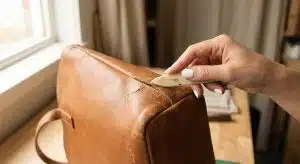
Can it be fixed? Yes, and this is where professional restoration excels. We strip the damaged finish, repair the surface, re-apply colour, and seal with a new topcoat. The result is leather that looks and feels like new.
3. Cracking from Dryness
Leather is skin. Like human skin, it dries out without moisture. Severely dried leather develops surface cracks that can progress to peeling as the grain layer separates.
How to tell: The surface shows a network of fine cracks (like a dry riverbed) before pieces start lifting. Can it be fixed? If caught early (cracking but not yet peeling), deep conditioning can halt the damage. Once the grain has started separating, professional repair is needed to fill, re-colour, and seal.
4. Manufacturing Defect
Some leather products have poor adhesion between layers from the factory. This is more common in mass-produced items where cost-cutting affects material quality.
Can it be fixed? Sometimes. If the leather itself is quality, re-bonding and refinishing works well. If the entire construction is compromised, repair may not be cost-effective.
DIY Fix for Minor Peeling
If the peeling is small (less than a coin-sized area) and the leather underneath looks intact, you can attempt a home repair.
What You’ll Need
-
- Fine-grit sandpaper (600-800 grit)
- Leather filler or flexible fabric glue
- Colour-matched leather paint or cream
- Leather finish/sealant
- Soft cloths and cotton buds
Step-by-Step
Step 1: Prepare the Surface
-
- Gently remove any loose, peeling material — don’t pull attached pieces
- Lightly sand the edges of the peeled area with fine sandpaper to create a smooth transition
- Clean the area with a damp cloth and allow to dry
Step 2: Fill and Bond
-
- If the peeling has created a depression, apply a thin layer of leather filler
- For lifted edges that are still attached, apply a thin line of flexible leather glue underneath the flap
- Press firmly and hold for 30 seconds
- Allow to dry completely (2-4 hours depending on product)
Step 3: Colour Match
-
- Once the filler/glue is dry and smooth, apply colour-matched leather paint
- Use thin coats — 2-3 thin coats are better than one thick coat
- Allow each coat to dry before applying the next (15-20 minutes between coats)
- Build colour gradually until it matches the surrounding leather
Step 4: Seal
-
- Apply a leather finish/sealant over the repaired area
- Extend slightly beyond the repair to blend with the existing finish
- Allow to dry completely
Step 5: Condition
-
- Apply leather conditioner to the entire item — not just the repaired area
- This prevents further drying and peeling elsewhere
Limitations of DIY Repair
Be realistic about what home repair can achieve:
-
- Small areas (under 2cm) can look very good
- Larger areas will be visible up close
- Colour matching is the hardest part — professional restorers have hundreds of colour shades and can custom-mix
- The repair is not permanent if the underlying cause (dryness, bonded leather breakdown) isn’t addressed
- Designer items deserve professional care — a botched home repair can reduce resale value
Professional Peeling Leather Restoration
At our Alserkal Avenue workshop, here’s how we handle peeling leather:
Assessment
We first determine what the material actually is (full-grain, top-grain, bonded, or synthetic) and what’s causing the peeling. This takes 5-10 minutes and determines whether repair is worthwhile.
The Process (Real Leather)
-
- Strip — remove all loose and damaged finish using specialist compounds
- Repair — fill any depressions or cracks with professional leather filler
- Sand — smooth the surface to factory-level evenness
- Prime — apply an adhesion promoter for the new colour coat
- Colour — spray-apply matched leather dye in thin, even coats (we can match any colour including metallics and two-tone finishes)
- Seal — apply a protective topcoat matched to the original finish (matte, semi-gloss, or gloss)
- Condition — final conditioning to ensure flexibility
The result is a surface that looks, feels, and wears like the original. For high-quality leather, this repair can last many years with proper care.
Prevention: How to Stop Leather from Peeling
Prevention is straightforward and applies to all leather goods:
Condition Regularly
This is the single most important thing you can do. Leather conditioner keeps the material supple and prevents the drying that leads to cracking and peeling.
-
- In Dubai’s climate: Condition every 4-6 weeks. Our AC-heavy environment strips moisture from leather faster than temperate climates.
- General recommendation: Every 2-3 months for items in regular use
- Stored items: Condition before storing and every 3-4 months during storage
Protect from Heat and UV
-
- Never leave leather goods in a hot car — dashboard temperatures in Dubai can exceed 80°C
- Avoid prolonged direct sunlight
- Store away from windows
Avoid Chemical Contact
-
- Keep hand sanitiser away from leather — the alcohol destroys the finish
- Don’t use household cleaners (Dettol, bleach, all-purpose sprays)
- Apply perfume before putting on leather accessories, not after
- Use only products designed specifically for leather care
Store Properly
-
- Use dust bags for handbags
- Stuff bags with acid-free tissue paper to maintain shape
- Use shoe trees for shoes
- Allow airflow — don’t wrap in plastic
For our complete storage guide: How to Store Luxury Handbags: Expert Tips.
Common Brands and Peeling Issues
Why Do Expensive Shoes and Bags Still Peel?
Even premium brands can experience peeling. The finish on a €1,000 shoe is still a chemical coating that can break down. However, the underlying leather on luxury items is almost always repairable — unlike bonded leather products.
Designer Items We Commonly Restore
We regularly restore peeling leather on:
-
- Louis Vuitton — the Vachetta leather trim on LV bags is especially susceptible to water staining and finish damage
- Gucci — GG canvas items with leather trim often see peeling at wear points
- Prada — Saffiano leather is durable but the internal leather components can peel
- Christian Louboutin — the red sole finish is designed to wear, but upper leather finish can peel from heat and dryness
- Chanel — lambskin is delicate and prone to finish issues from chemical exposure
If you own a designer item with peeling leather, don’t panic and don’t DIY. Professional restoration preserves the item’s value and appearance.
Frequently Asked Questions
Is peeling leather real leather?
Not always. Bonded leather and PU (polyurethane) leather commonly peel because their synthetic top layer breaks down over time. Real full-grain leather can peel if the finish is damaged, but the leather itself doesn’t delaminate. If the peeling reveals a woven fabric underneath, it’s likely not real leather.
Can a cobbler fix peeling leather shoes?
A skilled leather restorer (not just a cobbler) can fix peeling on real leather shoes by stripping the damaged finish, re-colouring, and sealing. For bonded or synthetic leather, the fix is temporary. The key is finding a specialist with colour-matching expertise.
How long does a peeling leather repair last?
On real leather, a professional restoration can last 3-10+ years with proper care. On bonded or synthetic leather, expect 1-2 years before the underlying material continues to degrade. Regular conditioning after repair extends the lifespan significantly.
Should I use super glue to fix peeling leather?
No. Super glue (cyanoacrylate) dries rigid and will crack with the natural flex of leather. It also stains and discolours leather permanently. Use flexible leather adhesive or professional leather cement instead.
How much does it cost to fix peeling leather?
Professional leather repair for peeling typically ranges from AED 200-600 for shoes and AED 300-1,200 for handbags, depending on the extent of damage and the item’s size. We provide a free assessment before any work begins.
Italian Shoe Factory has been Dubai’s trusted leather restoration specialist since 1994. Based at Alserkal Avenue, we restore peeling, cracked, and damaged leather on shoes, handbags, jackets, and accessories. Same-day pick-up across the UAE. Book your restoration today →
