
Every pair of shoes reaches a point where you have to make a decision. Is it worth fixing, or is it time to let go? For cheap shoes, the answer is usually obvious. For quality leather footwear, the calculation is more interesting — and the right answer is often not what people expect.
The basic rule of thumb
If the cost of repair is less than a third of the replacement cost, repair almost always makes sense. If the shoes are well-made, the repair will hold and you’ll extend the life of a good pair significantly.
For example: a pair of leather dress shoes that cost AED 1,200. A heel replacement and sole conditioning costs AED 250. That’s less than 21% of the replacement cost, and after the repair the shoes have years of life ahead. Easy decision.
The calculation changes if the repair cost approaches or exceeds the replacement cost, or if the shoes are poorly made to begin with.
Repairs that are always worth doing
Heel tip replacement
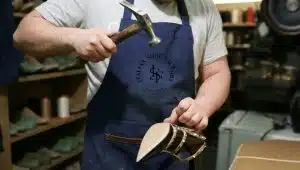
Heel tips wear down with every step. When the rubber is gone, the hard heel base starts to wear, which creates a larger and more expensive problem. Replacing heel tips costs AED 80–150 and prevents AED 300–600 of heel reconstruction later. There’s no scenario where this isn’t worth doing on a quality pair of shoes.
Sole protectors on new shoes
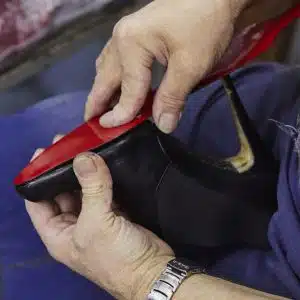
Adding a thin rubber sole to a new leather-soled shoe before you start wearing it can triple the life of the original sole. Cost: AED 80–120. Worth it every time.
Conditioning and cleaning
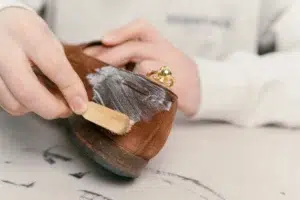
Not technically a repair, but neglected conditioning leads to leather that cracks and eventually needs replacing. Regular conditioning extends the life of leather shoes by years.
Minor stitching repairs
If the welt or upper stitching is coming loose in one spot, fixing it early is a simple job. Left alone, it becomes a full welt replacement.
Repairs that depend on the shoe’s quality
Full resole
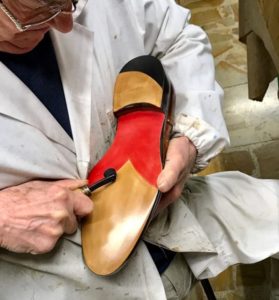
Resoling a quality shoe — one with a proper Goodyear welt or Blake stitch construction — makes complete sense. The upper is the expensive part, and a new sole gives it another decade of life.
Resoling a glued or cemented shoe is a different story. Many high street and fast fashion shoes are glued rather than stitched, which means the sole can’t be properly replaced. A glued repair is temporary. If the shoe has no structural welt, resoling is rarely worth the cost.
Leather restoration and colour work
On a high-quality piece, leather restoration that involves cleaning, re-dyeing, and conditioning makes sense and will look excellent. On a low-quality shoe with cheap leather, restoration won’t hold as well and may look patchy.
Signs a shoe is worth repairing
- It’s made from full-grain leather (check the insole — good shoes usually say)
- It has a Goodyear welt or visible stitching around the sole
- The upper is structurally sound
- You’ve had them for years and they’re already broken in and comfortable
- They’re a classic style that won’t date
Signs it’s time to replace
- The upper leather has cracked through — not scuffed, but cracked. Surface cracks in leather are almost impossible to fully restore.
- The shoe has lost its shape and the internal structure has collapsed
- The insole is destroyed and the shoe is uncomfortable despite new soles
- The construction was cheap to begin with — cemented soles, synthetic leather, thin lining
- The repair cost is more than 50% of the replacement cost
The environmental case for repair
New shoe manufacturing is resource-intensive. A quality leather shoe requires significant leather, dyes, rubber, and stitching, plus the energy involved in production and shipping. Repairing a shoe that already exists is almost always lower impact than buying a new one.
For people who care about this, the case for repair is strong — particularly for high-quality leather footwear that was made to last.
A practical decision framework
Ask yourself these questions:
- Are the shoes well-made? If yes, continue. If no, probably replace.
- Is the upper structurally sound? If cracked through, replace.
- What does the repair cost vs replacement cost? If repair is less than 30–40%, repair.
- Are they comfortable when they fit properly? If yes, worth repairing. Good fit is hard to find.
- Do you actually like the shoes? If you’ve always found them mediocre, this might be the moment to upgrade.
For most quality leather shoes, the answer is to repair. A well-made shoe repaired properly can genuinely last a lifetime.
Get a shoe repair quote in Dubai →
